Water Care
Commercial Cold Plunge Water Treatment Explained
By Odyssey Plunge · 2026-11-25 · 4 min read
Shared-use water requires a measurable disinfectant residual, a written operating routine and staff who know when to close the bath. That sentence contains the whole subject, and the rest of this article is an explanation of why each part of it is there.
A domestic plunge can be run on circulation, filtration and good habits. A commercial one cannot, because the contamination load is higher, the users are strangers to each other, and somebody is paying to get in.
Choose the treatment route for the bather load
Odyssey's September 2026 commercial manual describes two routes, and the right one depends on your site rather than your preference.
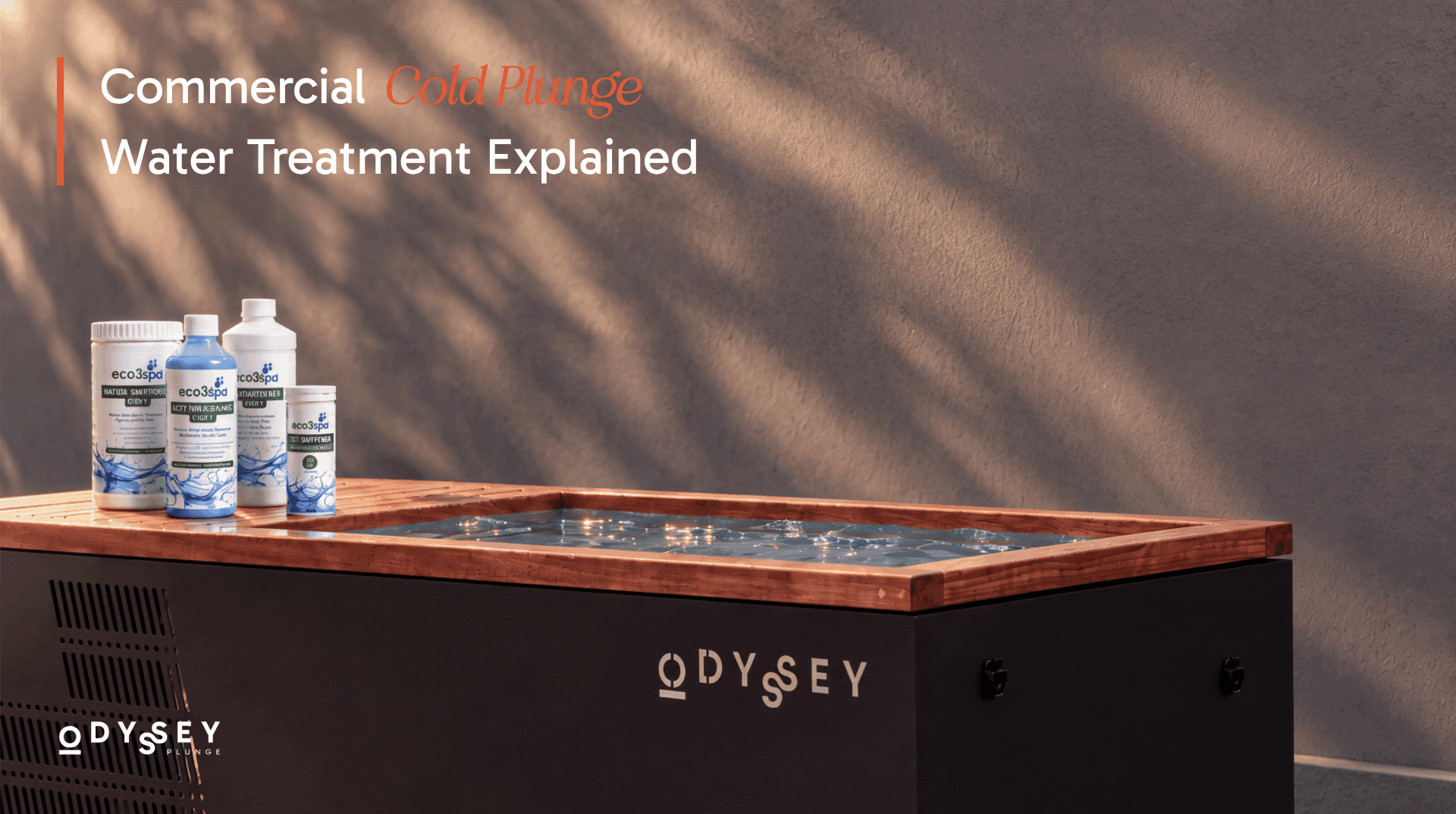
Light-commercial with controlled use. Where bather numbers are modest and access is managed, a site can manually test and maintain an approved residual sanitiser such as Eco3Spa. This relies on someone actually performing the tests at the stated frequency, so it suits sites with a reliable routine and a limited peak.
Mid-to-heavy commercial. A busier site can use automatic chlorine and pH dosing, which maintains the residual continuously and logs what it is doing.
The choice depends on peak use, the installed plant and a site-specific risk assessment. It is not permanent either. A light-commercial setup should be reviewed if its residual becomes hard to maintain, or if demand grows beyond what it was specified for. Growth is a good problem, but it is still a problem if the treatment route does not grow with it.
Give each treatment stage its job
A treatment loop is a series of stages that each do one thing. Expecting any one of them to cover for another is the most common design mistake.
- Pre-use showers reduce the load entering the system before it ever reaches the water. This is the cheapest stage and the most often skipped.
- Surface skimming removes floating contamination, which is where a lot of it sits.
- The pre-filter catches the coarse material.
- A cartridge or specified media filter removes suspended material from circulating water.
- UV or ozone, where fitted, acts on water as it passes through. It does not provide a persistent residual out in the bath itself.
- A properly maintained residual sanitiser addresses contamination between passes, in the water people are actually sitting in.
- Automatic dosing, where fitted, controls the chemical feed.
Two things that follow from this list and are worth stating directly. UV and ozone are not substitutes for a residual, because they only act on water inside the plant. And automatic dosing cannot correct a blocked filter, failed circulation or an excessive bather load. It will keep dosing into a system that is not working and report that it is doing its job.
Test independently and record the result
Before opening, inspect clarity and flow and test the appropriate residual.
On chlorine-controlled systems, verify free chlorine and pH manually, even when a controller displays readings. A controller reports what its probe believes, and probes drift. The manual test is the check on the machine.
Retest during the day as the site procedure requires, and particularly after heavy use. A reading taken at eight in the morning tells you very little about four in the afternoon.
Log all of it:
- Test results, with times
- Filter cleaning
- Chemical changes and deliveries
- Faults
- Corrective actions taken
The log is not bureaucracy. It is the only way to see a trend before it becomes an incident, and it is the first thing anyone will ask for if something goes wrong.
On chemical handling: keep chlorine and acid in separate, labelled, compatible containers, follow the site COSHH controls, and never mix them. That is not a cautious formality.
Clean, and know when to close
Odyssey's manual calls for at least weekly pre-filter and paper-cartridge rinsing, with more frequent cleaning when use demands it. It gives a typical cartridge replacement interval of four to six weeks, and a weekly commercial water-change baseline, shortened as needed.
Treat those as starting points that commissioning and your own risk assessment will adjust. A busy site in summer will not hold a four-week cartridge.
Close the bath immediately for:
- Failed circulation
- A residual that cannot be maintained
- Unsafe pH on a chlorine system
- Cloudy water
- Suspected contamination
Correct the cause and verify water quality before reopening. Reopening because the queue is building, without a verified test, is the decision that turns an inconvenience into an incident.
Why no numbers appear here
You will notice this article quotes intervals but not chemical targets. That is deliberate.
Commissioning and the venue's risk assessment set the actual operating ranges and monitoring frequency for your installation. A figure that is correct for one site, with its particular volume, turnover, bather load and plant, can be wrong for another. Publishing a target would invite somebody to use it instead of their own operating procedure.
If you do not have a site-specific procedure with real numbers in it, that is the gap worth closing first.
A short checklist for operators
- Do we know our peak bathers per hour, and is the treatment route specified for it?
- Does every opening check include a manual residual and pH test?
- Is the log complete for the last month?
- Does every member of staff on shift know what closes the bath, and have they the authority to do it?
- When was the last cartridge change, and is the interval holding?
Next step: Ask Odyssey to specify the appropriate treatment route, commissioning plan and staff handover for your site.